
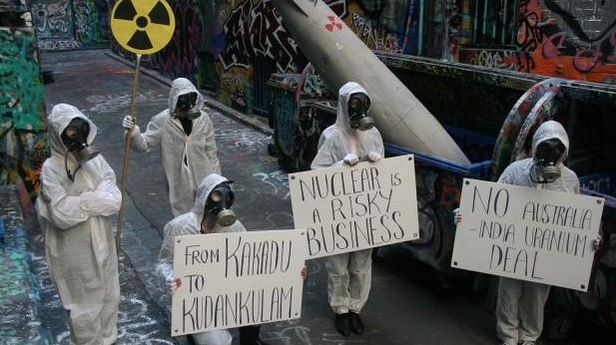
 While Prime Minister Tony Abbott and Foreign Minister Julie Bishop have been strong supporters of selling Australian uranium to India many others, including key Australian diplomats and insiders, remain far more circumspect.
The plan has drawn sustained opposition and concern, most recently from the federal Parliament’s influential Joint Standing Committee on Treaties (JSCOT) which has unambiguously stated that much more work is required before any Australian uranium makes a passage to India.
That Committee’s recent report urges that ‘Australian uranium not be sold to India‘ at this time. It’s hard to get much clearer than that. This is a considered and credible red light to commencing any uranium exports before serious and unresolved domestic and international concerns are addressed.
The JSCOT report followed a detailed examination and expert testimony and states that while the Federal Government can ratify the deal it must not advance uranium sales or supply to India before key checks and balances are put into practice, and proven to work.
In short, the committee charged with advising the Government on Indian uranium sales has reached the unambiguous conclusion that the Government can sign but not sell.
The question now is whether the Abbott Government will follow due parliamentary process and act in the public interest or will it ignore these concerns and JSCOT’s advice and seek to fast-track the agenda of the under-performing uranium sector?
When Prime Minister Tony Abbott signed a uranium deal with Indian Prime Minister Narendra Modi in New Delhi in September 2014, he praised India’s “absolutely impeccable non-proliferation record”. Yet India’s record on nuclear proliferation tells a quite different story.
Source: Independent Australia


